Research

Regularity, approximation and adaptivity

I work at the interface of function spaces, partial differential equations and approximation theory, with growing connections to deep neural networks and nonlocal models. The regularity of a function determines how efficiently it can be approximated, and this principle connects my theoretical work on Sobolev, Besov and Kondratiev spaces with adaptive finite element and wavelet methods, sampling algorithms and neural network approximation. It applies to low-dimensional problems with difficult geometry as well as to high-dimensional settings in which dimension-independent approximation is essential.

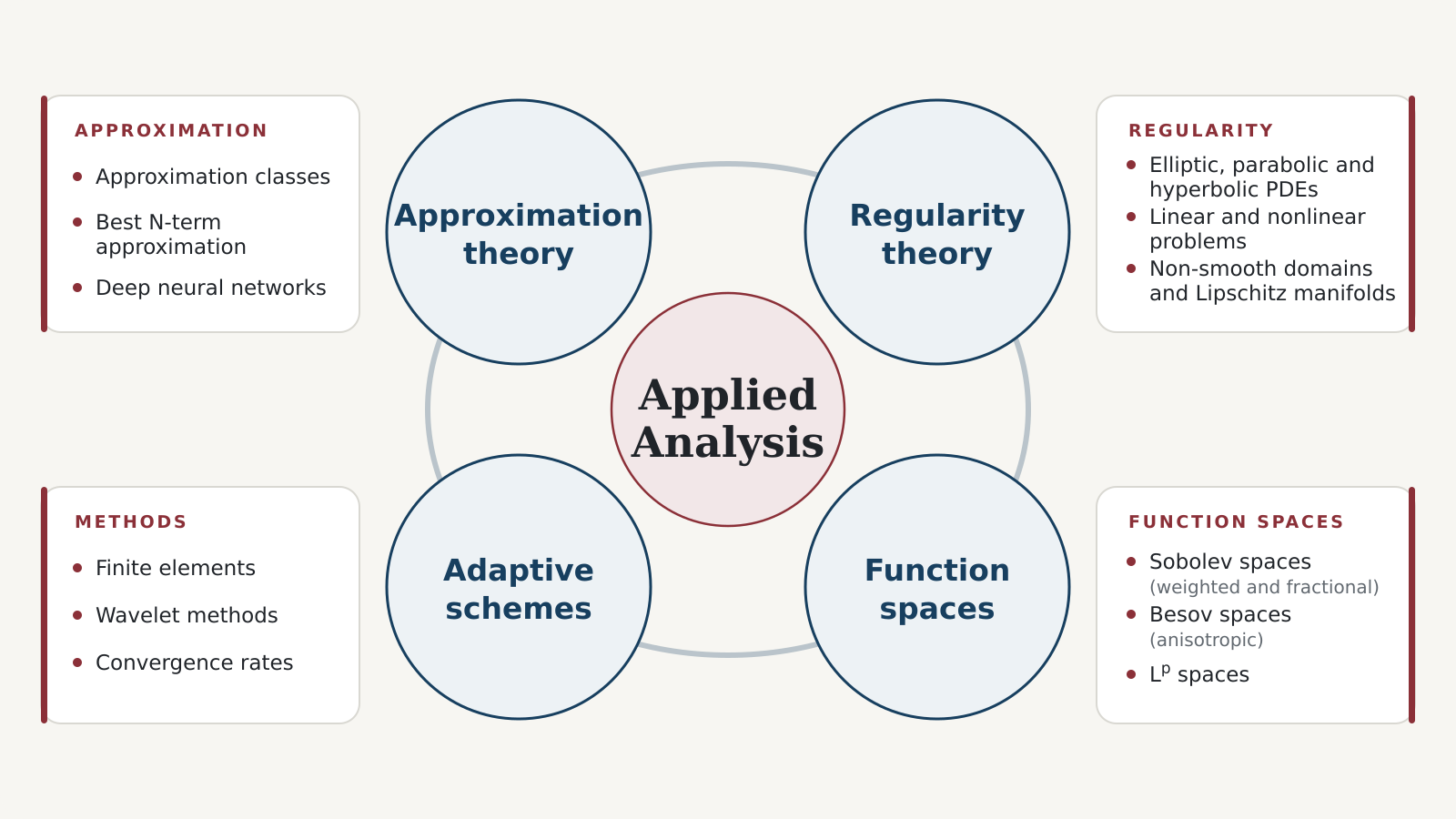
Four interlinked research areas around the centre 'Applied Analysis': approximation theory, regularity theory, adaptive schemes and function spaces, with keyword panels for approximation, regularity, methods and function spaces.
Approximation theory, regularity theory, adaptive schemes and function spaces — the four interacting pillars of my work in applied analysis. Swipe sideways to see the whole diagram.

The projects in detail

Regularity of (S)PDEs on non-smooth domains and manifolds

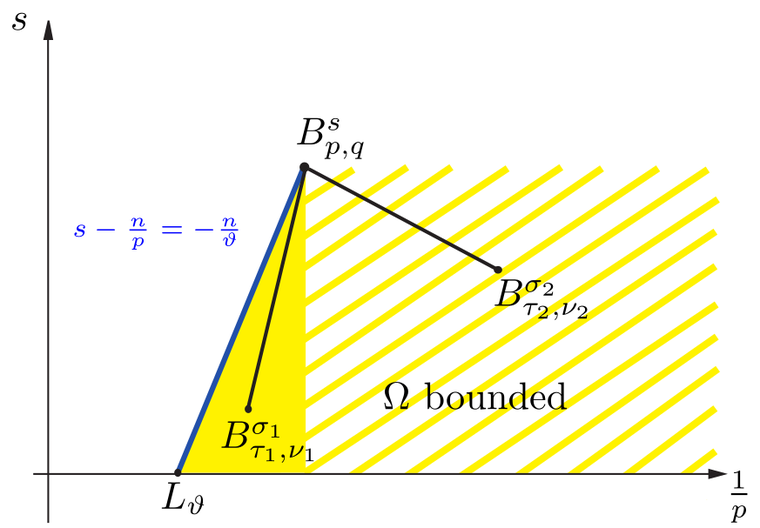
I study Sobolev and Besov regularity for elliptic, parabolic and hyperbolic problems on domains with corners, edges and other singularities. The central goal is to explain rigorously when adaptive approximation can outperform uniform methods: adaptivity pays off precisely where the Besov regularity of a solution exceeds its Sobolev regularity.

Current directions include evolutionary PDEs, stochastic problems, Lipschitz manifolds and long-term questions connected with the Navier–Stokes equations.

The Besov regularity is usually obtained via weighted Sobolev (Kondratiev) spaces, whose weight measures the distance to the singular set of the domain, while non-adaptive schemes are governed by regularity in fractional Sobolev spaces. For elliptic problems the picture is essentially complete. Much less is known in the parabolic setting, whereas for hyperbolic conservation laws regularity results are so far limited to the one-dimensional case.
Besov versus Sobolev smoothness in the DeVore–Triebel diagram: the adaptive and the uniform approximation line.

Approximation with deep neural networks

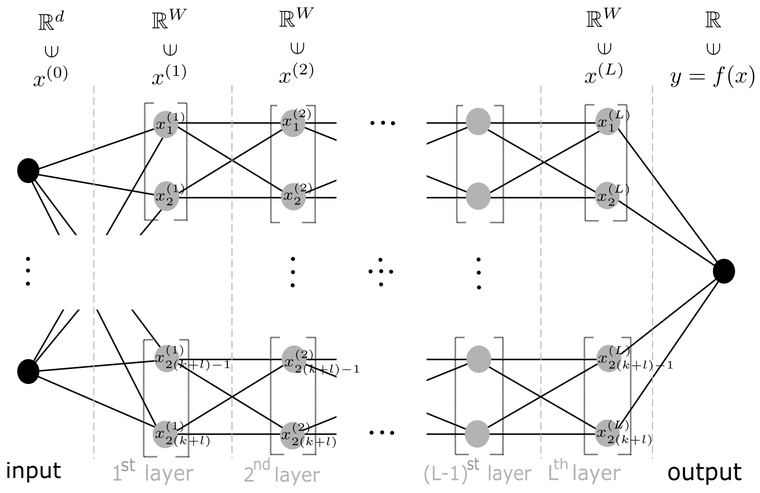
This project investigates systems of piecewise polynomial functions that are exactly representable by ReLU-type networks and form bases of Lebesgue, Sobolev and Barron spaces. The basis perspective keeps the approximation constants explicit and, in suitable settings, avoids the curse of dimensionality.

Next steps include higher-order activations, smoothness beyond one, integrability indices other than two, sampling recovery and applications to PDE approximation.

Daubechies, DeVore, Foucart, Hanin and Petrova introduced such a system for L2([0,1]); we extended it to the multivariate setting and showed that it also forms a Riesz basis for Sobolev spaces and Barron classes of smoothness below one. Because the proofs avoid local approximations, the implicit constants remain visible, which is what makes the dimension-independent rates provable.

A deep ReLU network realising linear combinations of the basis functions.

Space-time adaptivity via tensor wavelets

Fully adaptive space-time schemes can exploit anisotropy in both the spatial and the temporal variable. I investigate their connection with Besov spaces of dominating mixed smoothness, where the achievable rate no longer depends on the spatial dimension, and compare them with uniform tensor-product and time-marching methods.

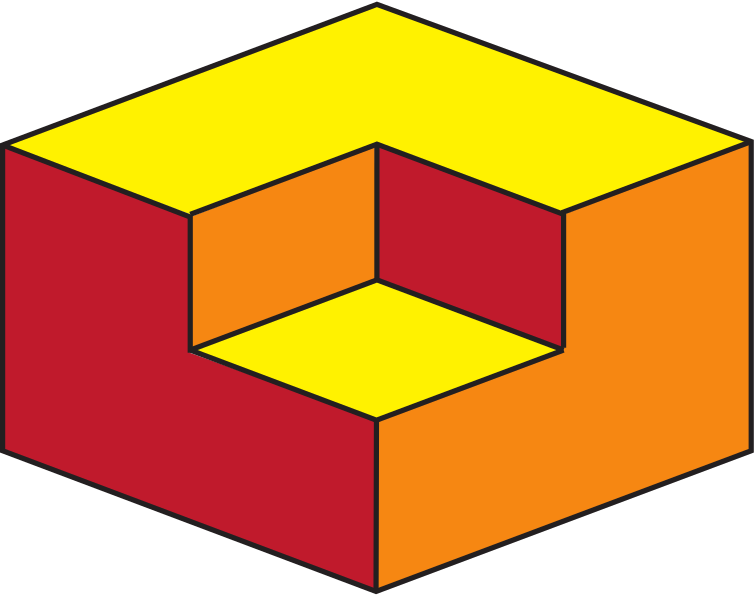
The programme begins on product domains and extends towards non-smooth geometries such as L-shaped domains and the Fichera corner.

Adaptive methods reach a rate O(N−α/d) that still degrades with the spatial dimension d, whereas tensor-wavelet schemes reach O(N−α). The comparison with non-adaptive schemes is delicate, since those are governed by Sobolev rather than Besov spaces of dominating mixed smoothness, and the relation between these two scales is itself hard to pin down.

The Fichera corner, a model domain with edge and vertex singularities.

Nonlocal gradients and variable-order models

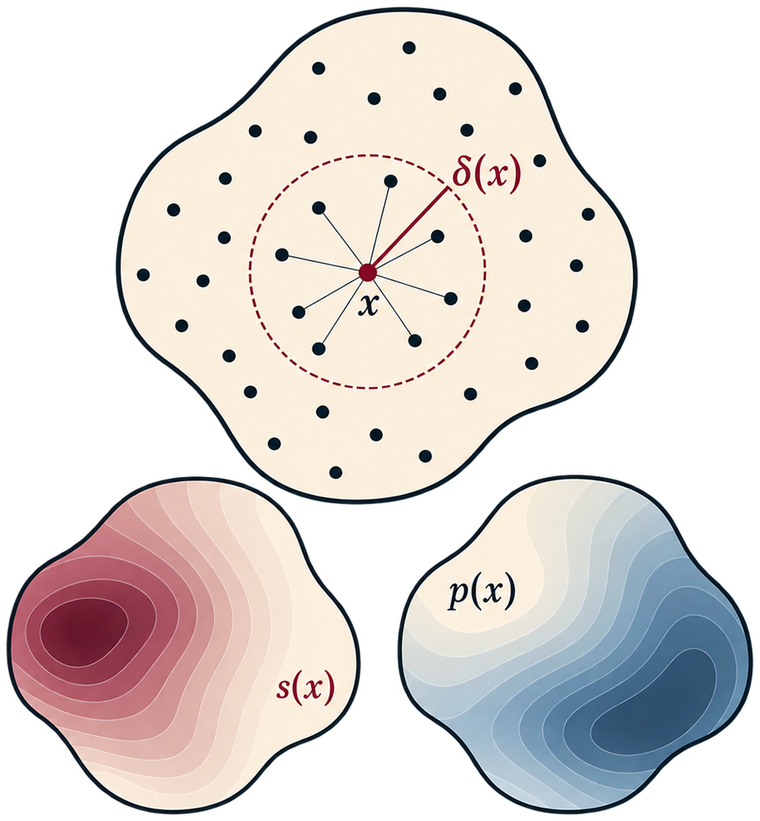
Motivated by peridynamics and heterogeneous materials, we plan to study nonlocal gradients with spatially varying smoothness and variable integrability (and with anisotropic kernels). Such models lead to new spaces of nonlocal Sobolev type and to questions about embeddings, compactness and existence.

A central goal is to quantify the nonlocal-to-local limit with explicit rates.

Peridynamics describes fracture and damage through interactions over a finite horizon, and realistic materials such as composites or functionally graded media have spatially varying microstructure and therefore varying interaction ranges. Unlike the fractional Laplacian, nonlocal gradients admit a duality-based framework for Sobolev-type spaces, which is what makes the variational theory work.

A body with nonlocal interactions: a point x interacts with all points inside its horizon of radius delta(x); below, the same body carrying a spatially varying smoothness s(x) and a variable integrability p(x).
Nonlocal interaction over a horizon δ(x), with spatially varying smoothness s(x) and variable integrability p(x).

Approximation classes for evolutionary PDEs

This work develops direct (and inverse) estimates and approximation classes for adaptive time-stepping and space-time finite element methods, combining Jackson- and Whitney-type estimates, anisotropic Besov smoothness and near-best approximation algorithms.

The aim is to understand which regularity conditions are sufficient — and ultimately necessary — for a prescribed convergence rate.

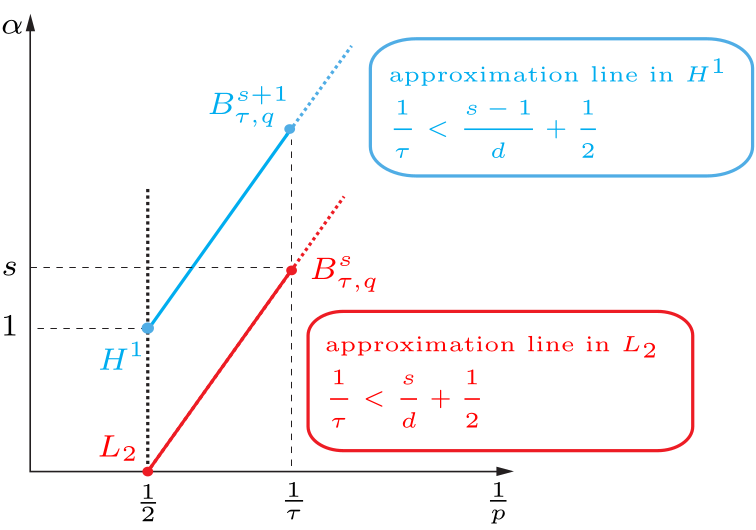
For s > 0 the class 𝔸s consists of the functions whose best N-term approximation error decays as N−s, with N standing for the degrees of freedom and hence for the computational cost. Our first results treat time-marching by Rothe's method and suggest that time-stepping is not optimal here, which is why we now investigate full space-time approximation.

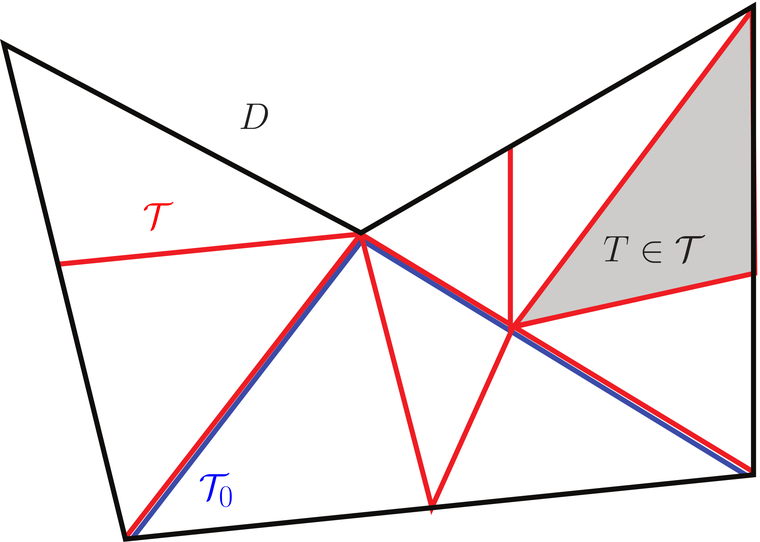
Refinement of a triangulation: an element marked for subdivision.

Function spaces and a-priori estimates

Traces, embeddings, weighted smoothness and constructive decompositions are the tools the other projects run on, and subjects in their own right.

Using building blocks such as atoms, wavelets or quarks instead of Fourier-analytic techniques should yield a-priori estimates for elliptic PDEs even in complicated scales such as smoothness Morrey spaces.

Conventional a-priori estimates rest mainly on Fourier-analytic techniques, which limits the scales of spaces they can reach. A constructive approach should carry them into scales such as smoothness Morrey spaces, where the Fourier methods break down.

Embeddings on a bounded domain.

Full list of publications → Back to the overview

Scientific network

  • Germany
  • Austria
  • Czech Republic
  • Poland
  • Portugal
  • India
  • USA
  • Argentina
Erlangen

Julian Billner, Samuel Probst, Nick Schneider, Florá SzemenyeiFAU Erlangen-Nürnberg, Germany

Marburg

Stephan Dahlke, Markus Hansen, Christian RiegerPhilipps-University Marburg, Germany

Jena

Dorothee D. Haroske, Winfried Sickel, Kristóf SzarvasFriedrich Schiller University Jena, Germany

Jena

Henning KempkaErnst-Abbe-Hochschule Jena, Germany

Würzburg

Markus WeimarJulius-Maximilians-Universität Würzburg, Germany

Kassel

Petru Cioica-LichtUniversity of Kassel, Germany

Freiburg

Nadine GroßeUniversity of Freiburg, Germany

Berlin

Gabriele SteidlTU Berlin, Germany

Neubrandenburg

Gerd TeschkeHochschule Neubrandenburg, Germany

Linz

Mario UllrichJohannes Kepler University, Austria

Prague

Vladimir Kulbatov, Jan VybíralCzech Technical University, Czech Republic

Poznań

Leszek SkrzypczakAdam Mickiewicz University, Poland

Coimbra

Susana D. Moura, Júlio S. NevesUniversity of Coimbra, Portugal

Mandi

Qaiser JahanIndian Institute of Technology Mandi, India

Columbus

Jan LangThe Ohio State University, USA

Santa Fe

Marcelo Actis, Fernando Gaspoz, Pedro MorinUniversidad Nacional del Litoral and CONICET, Argentina